Wallet Session Invalidation After Account or Chain Changes
Separate provider context, authenticated identity and action permissions. Use a fictional delayed-response scenario to specify session rules and test evidence.
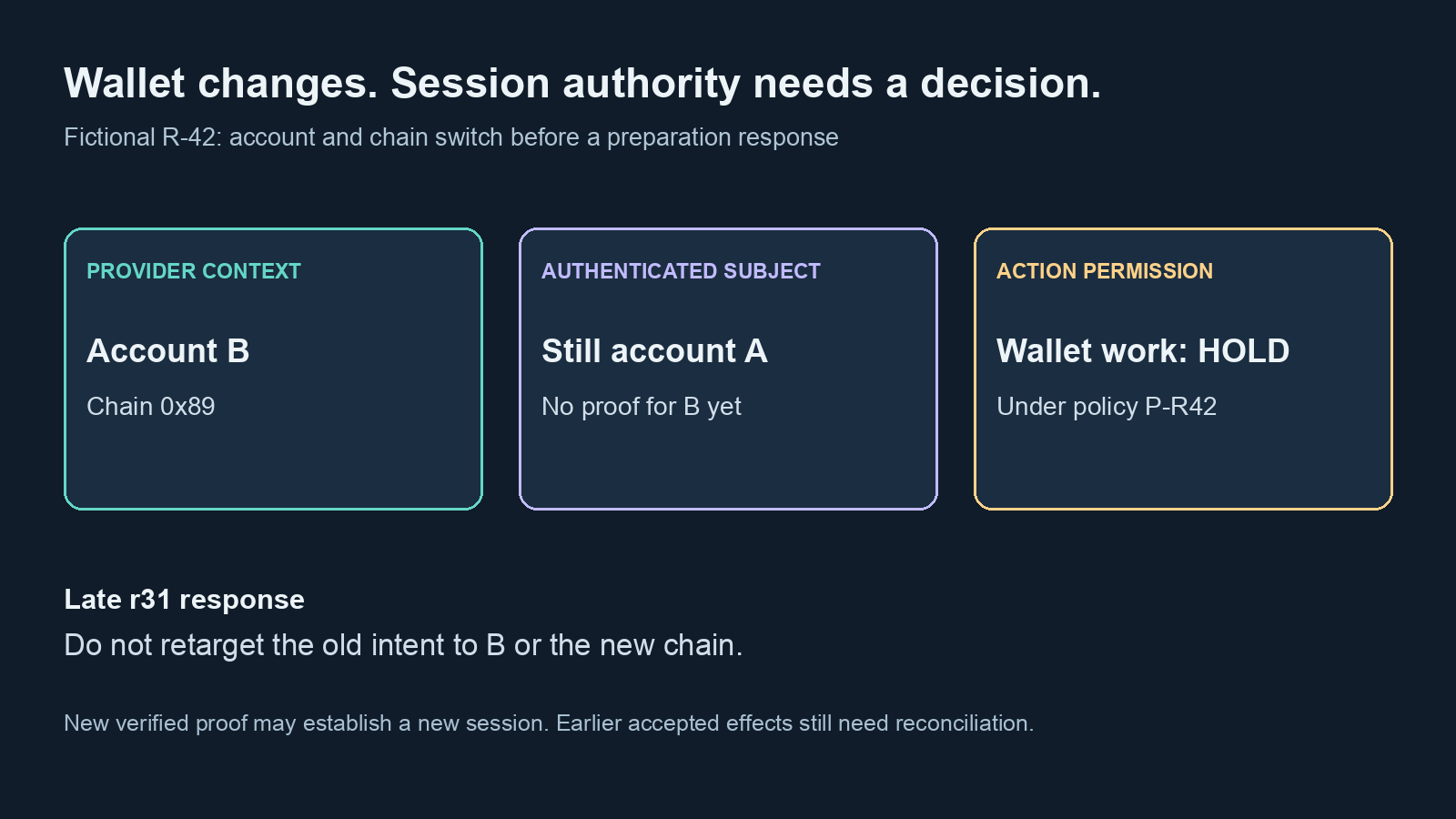
Wallet session invalidation should follow an explicit application policy for the requested action. A provider event changes the wallet context the application observes. It does not, by itself, authenticate a different user or revoke a server session. After an account or chain change, stop using stale context, evaluate the affected permissions and obtain fresh proof wherever the chosen policy requires it.
The difficult case is an operation already in progress. A new account label can appear while an earlier request still carries the previous subject and network. A page reload may hide that disagreement without resolving it. Define what happens at the server's acceptance boundary, then test the response arriving after the switch.
This guide develops that decision using a fictional R-42 scenario and the paired Wallet Context Change Test Matrix. The scenario is a proposed design exercise. No wallet connection, production deployment or executed security test is claimed.
Separate provider context, authenticated subject and permission
Keep independent records for what the provider exposes and whom the application authenticated. Then evaluate whether that authenticated subject may perform the particular action. These records can disagree temporarily.
Treat disagreement as an explicit state so the application can resolve it.
EIP-1193 defines accountsChanged when the accounts returned by eth_accounts change, chainChanged for a changed connected chain and disconnect for loss of connectivity to all chains. These events describe provider state. They do not specify your application's complete authorization policy.
For example, account A may have authenticated to a server while the provider now exposes account B. The application should represent that mismatch directly. Replacing A with B in a frontend store supplies no proof that B signed in. Leaving A's session active also requires deciding which actions remain available under that identity.
Distinguish an account settings page from an instruction to prepare a contract operation. The former might depend only on the existing application session. The latter may require agreement between the authenticated address, the selected wallet and a supported chain. Write those conditions next to the action they protect.
A provider object, a login cookie and an operation request therefore need separate lifecycle decisions. Give each an owner in the architecture record. When a support ticket says the wallet disconnected, ask which of those states actually changed and which system observed it.
Preserve identity across an account change
When the exposed account changes from A to B, retire frontend work derived from A's selected-wallet context. Clear or partition address-specific cached views and stop offering an action whose prerequisites no longer match. Preserve the original subject in any existing request record so its meaning cannot drift toward B.
The application can require a new sign-in before any further authenticated work. It can instead retain A's application session while holding wallet-dependent actions. Either design needs an explicit rule and a visible explanation. A silent subject replacement supplies no fresh authentication result.
An empty accountsChanged list needs its own case. It tells the application that no account is currently exposed through that provider. It does not establish why access disappeared, whether another provider remains available or whether a separate server login was revoked. Hold actions requiring an exposed account and apply the approved application-session rule separately.
Avoid automatically opening a signing prompt whenever account exposure changes. A person may be inspecting another wallet or locking a device. Offer a clear route to authenticate the intended account, and verify that the account used for the proof still matches the intended transition when verification completes.
If several accounts are exposed, specify how the application chooses its active account. Do not let an incidental array position become an undocumented authorization rule. Record the selected account explicitly and handle a changed selection through the same policy as other account transitions. The test fixture should name the account list and the application's selected subject independently.
Reassess chain-specific work without inventing a logout rule
A chain change can invalidate contract addresses, balances and prepared transaction data associated with the previous network. Partition these values by chain and account. Reject a prepared instruction when its recorded context no longer satisfies the action's current prerequisites; do not rebuild its target silently from whichever network is now selected.
EIP-1193 represents the chainChanged payload as a hexadecimal chain ID. Normalize representations deliberately before comparisons. An application comparing a decimal string with a hexadecimal string should not turn a formatting mismatch into a mistaken authorization decision. Keep the original payload in sanitized evidence alongside the normalized value.
An unsupported chain should produce a defined hold or rejection path. Show which capability is unavailable and how the user can select a supported environment. A reconnect loop does not add support for that chain.
Do not repeatedly invite authentication when the missing prerequisite is network support.
Provider disconnection is another boundary. RPC unavailability can prevent chain reads or submission while an application session remains valid. Decide whether the product permits any independent account functions during that outage. Keep an already-submitted operation in a reconcilable state rather than marking it failed merely because the provider stopped responding.
The sign-in message's chain field and the application's action scope also serve different purposes. A signed message containing one chain ID is not a complete policy for every later operation on every network. State the supported scope in the application design and re-evaluate chain-dependent permissions when that scope changes.
Choose full invalidation or an action-scoped hold
Start with the operation inventory. For each protected action, name its authenticated subject, required wallet context, permitted network and additional business permissions. Specify the decision when any prerequisite becomes unknown. A hold can wait for fresh evidence; a denial rejects an ineligible request; reauthentication obtains a new identity proof.
Full application-session invalidation is comparatively simple to explain when the entire product depends on the selected wallet. Its cost is interruption of otherwise independent work. An action-scoped hold preserves approved capabilities, but it requires precise boundaries across endpoints and background workers. Choose it only when those boundaries can be implemented and reviewed consistently.
Use one policy revision across the frontend acceptance criteria and server authorization rules. A screen that disables a button while its endpoint still accepts the same stale request has implemented a presentation change. The protected operation remains authorized under the server's actual rules until those rules say otherwise.
OWASP summarizes the request-level obligation in its Authorization Cheat Sheet:
Validate the Permissions on Every Request
Apply that principle to ordinary requests and queued work. A job that runs later needs enough retained context to evaluate the applicable authority at its own decision boundary. Decide whether authorization is checked at enqueue time, execution time or both. Document what each decision permits.
For a retained session, make the user-facing state specific: signed in as A, selected wallet B, wallet-dependent actions awaiting verification. Avoid a single connected badge that conceals all three conditions. The state description should agree with the next action the server will actually permit.
Put revision checks at the server's decision boundary
A context revision associates asynchronous work with the state that created it. It is an application design choice, not a field mandated by EIP-1193. Advance the relevant revision when the policy makes prior wallet-dependent work obsolete, and carry that reference with the operation.
The client can use its revision to discard a stale response. The server needs an authoritative equivalent if the revision is intended to constrain authorization. Never trust a client-supplied number merely because it matches another client value. Bind the operation to server-validated identity and scope, then compare against the authoritative policy state.
The server does not automatically receive a wallet extension's events. Specify how a client reports a context transition and what that report is allowed to change. An authenticated request may conservatively place its own wallet workflow on hold, but an unverified account label must not grant authority for that account. Treat event notification and proof verification as separate inputs.
Also define what happens when that notification fails. The browser may have observed a switch while the server still holds the earlier policy state. Decide which protected requests require fresh evidence at submission, rather than relying on an earlier notification being delivered. A malicious client can omit a notification entirely, so any permission that depends on a current proof needs a server-verifiable prerequisite. Document the remaining trust assumption when the desired wallet-selection property cannot be established remotely.
Define the exact point at which the server accepts an effect. A revision comparison followed by an unrelated write can still leave a race if state changes between them. Use the transaction, conditional update or other concurrency mechanism appropriate to the actual storage design. The architecture review should identify that boundary rather than assert that a counter alone solves concurrency.
Aborting a browser request cannot undo work the server already accepted. An account switch arriving afterward may stop further activity while leaving an earlier operation to reconcile. Preserve its reference and inspect its outcome under the original identity and network. Do not resubmit the same intent automatically with B's credentials.
Likewise, an expired session cannot reverse an already-confirmed chain transaction. Separate preventing a future authorized action from interpreting an effect that already occurred. The acceptance record needs the operation's original context and its observed status even when the current screen shows a different wallet.
Walk through the R-42 delayed-response scenario
Consider a fictional application session R-42 authenticated as account A. The selected provider account is A on chain 0x1, and the application's wallet context is revision r31. A user starts intent I-08 to prepare a contract operation. Its request record binds A, 0x1 and r31 to the intended operation.
Before the preparation response returns, the provider exposes B and changes to chain 0x89. For this exercise, policy P-R42 holds wallet-dependent work whenever the selected account or chain differs from its approved context. The application marks its current context r32 and retires the old preparation view. These names are illustrative aliases. They are not literal account payloads.
Suppose I-08's preparation response then arrives carrying r31. The frontend should not display it as a preparation for B on the new chain. Under P-R42 it is stale for the current wallet workflow. The server's corresponding behavior depends on whether preparation merely produced data or had already accepted a privileged effect. That distinction must appear in the test fixture.
Next, the user deliberately authenticates B. Only after the expected proof is verified does the server establish the new subject and the application's accepted context become r33. This change does not retarget I-08.
A new operation must express B's intended action and pass the current chain and permission checks on its own terms.
Add the opposite timing order to the exercise: the server accepted an effect under r31 before the transition became authoritative. The expected outcome must preserve that earlier decision for reconciliation. A test that expects every pending operation to disappear after the switch would conceal the very race it is meant to examine.
Fill the paired matrix with an unambiguous expectation
Use the published matrix as a record format. Keep its nine fields intact, while putting scenario-specific policy detail in the expected decision and linked test ticket. For R-42, one proposed entry is:
- test_id: R42-LATE-PREPARE-01.
- initial_account: account A, fictional alias.
- initial_chain: 0x1, hexadecimal representation.
- provider_event: accountsChanged exposes B, followed by chainChanged to 0x89; a preparation response from r31 arrives afterward.
- session_revision: R-42, initial r31, transition r32; authenticated subject remains A pending separate verification.
- expected_application_decision: under P-R42, hold wallet-dependent work and discard r31 preparation from the current view. Preserve any separately accepted effect for reconciliation. Do not treat B as authenticated before proof verification.
- observed_result: NOT RUN, proposed exercise only.
- evidence_ref: NONE, no execution artifact exists.
- owner: authentication and operation-processing owners, roles to assign.
Split execution into additional records when the ordering changes the expected decision. Account change without a chain change, an empty account list and an unsupported chain need distinct fixtures. A single successful screenshot cannot establish all those branches.
When the exercise is run, replace the unexecuted status only with an observation supported by evidence. Record the application release and provider version in the linked ticket. Retain a sanitized event sequence, the original operation context and the actual server decision. Avoid placing bearer tokens or session cookies in the matrix.
If the backend decision cannot be observed, record that limitation.
A changed account heading supports a frontend observation; it does not establish that a stale request was rejected. Give the missing evidence an owner instead of converting a partial observation into a pass.
Establish a new session through verified proof
For a Sign-In with Ethereum flow, ERC-4361 binds the session to the address. Verify the signed message against its expected values and signature requirements before establishing that subject. Nonce handling and applicable time constraints belong in that verification, alongside the expected domain and request context.
The transition itself can race with sign-in.
A user may begin proving B, select C before the response returns and then receive a successful verification for B. Preserve what was actually verified. Either present the resulting mismatch under the approved policy or require the intended flow to restart. Never relabel the successful proof as authentication for C.
Bind each challenge to the intended sign-in attempt and handle its consumption through the server's authoritative state. Test a reused challenge and two concurrent verification attempts. Record how the implementation prevents an obsolete attempt from replacing a newer accepted session. A disabled signing button does not demonstrate those server properties.
Contract accounts need their supported signature-verification path. ERC-4361 includes invalidation guidance for changes to ERC-1271 implementations or dependent data that affect signature computation. Inspect those dependencies for the actual account implementation. A provider event listener alone cannot establish that a contract-backed authentication assumption remains valid.
Fresh authentication also does not automatically grant every business permission. A verified address may still lack access to a customer record or permission to operate on the selected contract. Preserve authorization checks after sign-in and name any resource-dependent assumption that needs re-evaluation. This guide leaves key recovery and delegated session-key capabilities to their separate reviews.
Reconcile startup, multiple tabs and provider replacement
An event-only design has a blind spot before listeners are attached and after a page resumes. Build a bootstrap and resynchronization step that reads the current supported provider state and reconciles it with the application's authoritative session. Specify how events arriving during that process are handled rather than assuming the initial snapshot stays current.
When a provider instance is replaced, detach obsolete listeners and identify the new instance in the integration record. A delayed event from an abandoned connection should not overwrite the active context. Test that lifecycle explicitly for the supported wallet connector; this article supplies no universal SDK event ordering guarantee.
Multiple tabs can retain different wallet views while sharing an application session. A tab-local revision cannot by itself invalidate authority in another tab. Use server-enforced session rules, and define how each client discovers the updated state before its next protected action. Local notifications can improve the interface. The server remains responsible for authorization.
Stateless tokens require a similarly explicit decision. Removing a token from one browser store does not demonstrate that another copy is unusable at the server. Document the chosen validity and revocation approach, including any accepted lifetime of earlier credentials. Test the policy the system actually enforces rather than the logout message it displays.
Wallet products and connection protocols can expose different lifecycle events. Maintain a compatibility record for each supported combination of wallet, connector and application release. Unknown or missing event behavior should lead to an explicit unsupported or held capability. Do not claim broad wallet compatibility from one browser extension exercise.
Require negative evidence before accepting the integration
Plan the evidence before the test run. For each fixture, compare the expected policy decision with the frontend state and the server's observed handling of the scoped request. Capture the sequence needed to explain a disagreement, including which context was authoritative when the operation crossed its acceptance boundary.
Exercise stale responses on both sides of that boundary. Before acceptance, demonstrate the intended rejection or hold under the current rule. After acceptance, demonstrate that the earlier effect remains traceable and is reconciled under its original scope. A timeout belongs to an uncertain-result path until the authoritative outcome can be established.
Add attempts to submit A's old operation after B authenticates, reuse an earlier sign-in challenge and continue wallet-dependent work with an empty account list. Include a request that reaches the server despite the frontend control being disabled. These checks distinguish presentation behavior from the permission the backend actually grants.
Keep failures legible. A signature mismatch, unsupported chain and unavailable RPC have different owners and recovery paths. Give the user a useful state while retaining sanitized technical evidence for the receiving team. Avoid copying raw authentication material into logs simply to make the record appear complete.
The release decision should name the tested environment and unresolved branches. Unsupported wallet behavior can remain outside the accepted scope if the product prevents the affected action and communicates that limitation. A branch awaiting evidence remains open. Neither an approved policy document nor this proposed scenario establishes an executed result.
Commission the missing session and wallet integration work
When provider changes update the interface but leave server authority undefined, Pharos Production's blockchain application development services cover wallet and decentralized application engineering. Scope the engagement around explicit deliverables: an action-policy inventory, an authentication transition design, enforcement at the server's acceptance boundary and reproducible negative-case evidence. The service description establishes relevant scope, not a completed result for your application.
Where the flow depends on a deployed contract or contract-account verification, include the corresponding smart contract development services work in the same brief. Identify who owns contract behavior and who owns application-session enforcement. A contract review cannot substitute for checks on an offchain endpoint, and a frontend fix cannot establish the contract's permissions.
Ask the receiving team to trace I-08 from its original subject and chain through the delayed response. They should be able to locate the policy revision, explain the authoritative acceptance point and find the evidence supporting the observed result. If one of those links is missing, preserve the gap as a named issue before approving the affected capability.
Use the broader blockchain integration readiness worksheet for the surrounding deployment and identity dependencies. Keep this article's acceptance record focused on session authority after wallet-context changes, with each remaining decision attached to the person who can resolve it.
Primary references and scope
- EIP-1193 provider specification: event semantics and connectivity.
- ERC-4361 Sign-In with Ethereum: verification, address-bound sessions and invalidation guidance.
- OWASP Authorization Cheat Sheet: request-level permission checks.
Sources checked October 23, 2026. The R-42 workflow and test entries are proposed, fictional design examples. No test execution or client result is reported. Standards authors and OWASP have not reviewed or endorsed this article.
More insights to read
- How to Build a Smart Contract Upgrade Operations Checklist
- Wallet Recovery Architecture: Key Ceremony, MPC, Social Recovery and Runbooks
- Five Smart Contract Upgrade Support Arrangements Compared
- How to Choose a Smart Contract Company for Upgrade Operations
- How to Write a Smart Contract Product Handoff Brief