Verify a Smart Contract Deployment: Chain, Bytecode and Proxy State
Connect the accepted build to a deployed instance and its actual implementation. A fictional D-18 packet shows why missing observations keep acceptance open.
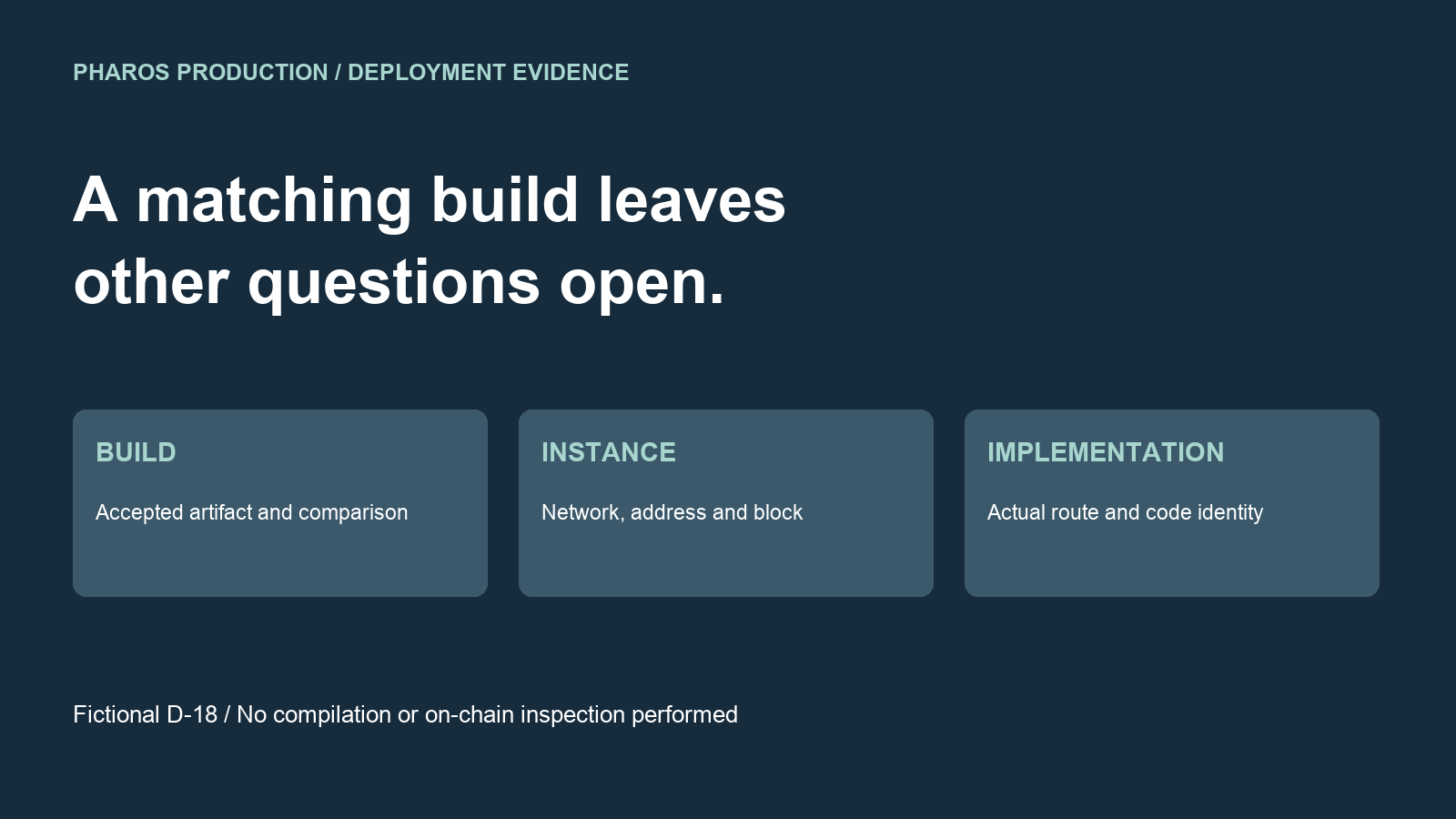
A smart contract deployment review should connect one accepted build to one deployed instance at a recorded observation point. For a proxy, it must also identify the implementation that supplies the logic. A repository revision, successful deployment receipt or source verification badge can contribute evidence, but each answers a narrower question than the complete handover.
Start with the connection that remains unproved. Can the reviewer reproduce the expected runtime? Does the observed address belong to the intended network? Is the proxy routing to the reviewed implementation? Has the required initialized state been inspected? Keep these conclusions separate so a passing check cannot conceal an unavailable one.
This guide proposes an evidence review using the published Smart Contract Deployment Manifest. Its D-18 example is fictional. No compiler, node, explorer verification, contract deployment or on-chain inspection was run for this article. The example demonstrates how to record an incomplete review, not how to certify a deployed system.
Freeze one artifact-to-instance question
Define the object under review before collecting screenshots. Identify the intended application contract, its accepted artifact and the deployment instance being considered. If users call a proxy, name that proxy separately from its implementation. A file called deployment-final can otherwise refer to the implementation creation while the receiving operator assumes it describes the user-facing address.
Write a bounded acceptance question. For example, the reviewer may need to establish whether a particular proxy used the accepted implementation at the recorded block. That question does not include permission to upgrade it, assurance about every business rule or confirmation of its present configuration after later changes. State those exclusions through the actual review scope.
Preserve the accepted references before investigating a discrepancy. Keep the source revision, build inputs and expected configuration under their original identities. If the team subsequently accepts a different artifact, create a linked acceptance revision. Replacing the expected file with whichever binary was found on-chain would erase the discrepancy rather than explain it.
The manifest is an index to evidence. Its fields should lead to retained material that another authorized reviewer can inspect. A populated form with inaccessible references remains an incomplete handover. Establish who owns those references and who receives the unresolved question before treating the record as usable.
Bind observations to a network and block
An address alone does not identify the intended deployment. Record the network identity and the observation block, including its hash where available. A chain ID is useful context, but it does not distinguish every fork or private environment. The evidence packet should explain which environment was queried and how the reviewer established that relationship.
Keep the collection time separate from the block being inspected. A historical observation collected today is still evidence about its selected historical state. A latest-state lookup performed during a release can change between requests. When the review needs a consistent snapshot, use a supported method that keeps related observations tied to the same state reference.
Connect the created instance to deployment evidence. A direct creation transaction and a factory transaction require different interpretation. For a factory deployment, identify the evidence linking the outer transaction to the created instance, such as an applicable trace or documented event. Do not assume the transaction receipt's contract-address field always supplies that relationship.
Record the project's confirmation policy and any unresolved observation limits. A transaction appearing in a block is different from meeting the project's acceptance condition. If a provider cannot supply the historical state needed for a check, mark the check unavailable and assign its next evidence request. An absent historical response does not establish an absent contract.
Keep deployment-time evidence and handover-time evidence distinguishable in the packet. An event can help locate a change, while a state observation answers what the reviewed mechanism exposes at the selected point. If those sources disagree, preserve the disagreement and investigate their applicability. Do not let the most recent explorer display silently replace the state reference used by the original acceptance question.
Recover the build that the team accepted
Retain the complete compiler input and output needed to explain the expected artifact. Include source contents, exact compiler version, optimizer configuration, EVM target and applicable library addresses. A source commit helps locate code, but a commit without its dependency and build context may not reproduce the binary the team accepted.
Solidity's compiler documentation distinguishes creation bytecode from deployed bytecode and exposes references used for linking and immutables. Preserve the relevant output object and the method that interprets it. Comparing an address's runtime directly with the creation program would compare different objects before any meaningful deployment conclusion could be drawn.
Libraries and constructor-assigned immutable values need explicit treatment. The runtime stored on-chain can contain values filled during compilation, linking or creation. Record where those values came from and how they were checked. A comparison that simply ignores every differing range would conceal the very connection the reviewer is meant to establish.
Build custody also matters. Retain hashes or other immutable identifiers for the files actually reviewed, together with the acceptance reference. Keep secrets outside the packet. An evidence export should allow a reviewer to identify and reproduce the intended comparison without distributing deployment keys, private credentials or unrelated operational data.
Choose a runtime comparison that preserves differences
Declare the comparison method before assigning its result. A whole-binary exact match, an executable-code comparison with documented exclusions and an explorer's source verification result are different claims. Record which one was performed and what it can establish. Avoid reducing all three to a generic verified label.
Solidity's contract metadata documentation explains how metadata and compiler settings relate to bytecode. Source paths and metadata choices can affect the resulting binary. If a method separates metadata from executable code, retain the original bytes, the parsing method and the excluded region. Explain the remaining difference rather than silently deleting it.
- Comparison object: Whole deployed runtime; Evidence the reviewer needs: Expected linked runtime and observed code at the recorded block; Limit to preserve: Exact equality concerns these bytes and this observation.
- Comparison object: Runtime with documented substitutions; Evidence the reviewer needs: Compiler references, actual substituted values and comparison output; Limit to preserve: Every excluded or replaced range needs an explanation.
- Comparison object: Metadata component; Evidence the reviewer needs: Retained bytes, applicable format and build metadata; Limit to preserve: A metadata difference is not automatically a harmless difference.
- Comparison object: Explorer source verification; Evidence the reviewer needs: Exact explorer result, network, address and supplied build inputs; Limit to preserve: A source match does not establish initialized state or audit acceptance.
Do not repair an unexplained mismatch by broadening exclusions after seeing the result. First determine whether the expected build is wrong, the observed instance is different or the method is incomplete. Record a revised method as a new review step, retaining the earlier output and the reason for the change.
An equality result also needs interpretation. It supports code identity within the declared comparison scope. It does not prove correct business behavior, safe permissions or the absence of vulnerabilities. Those questions require their own evidence, even when the deployment's source and binary relationship is well documented.
Make the comparison report reproducible as a document too. Record the tool or procedure revision, input identifiers, output location and reviewer interpretation. If a manual step supplies a library address or immutable value, identify its evidence source. The receiving engineer should be able to determine which decisions were performed by software and which were accepted by a person.
Resolve the proxy pattern before the implementation
Inspect the actual deployed mechanism and version. The ERC-1967 specification defines distinguished storage locations for implementation and beacon information. Those locations are useful evidence for applicable proxies. They do not turn a single storage read into a universal detector for every delegation architecture.
For an implementation-slot arrangement, retain the observed implementation reference at the selected block and explain how it was interpreted. Keep the proxy's own runtime evidence beside it. The proxy bytecode can remain unchanged while its selected implementation changes, so checking only the proxy's source relationship leaves the logic identity unresolved.
A beacon arrangement adds another relationship. The reviewer needs the beacon used by that proxy and the implementation resolved through it at the relevant observation point. The OpenZeppelin proxy reference documents version-specific behavior, including a BeaconProxy that retains its beacon in an immutable variable. Inspect the actual mechanism rather than assuming a storage slot alone describes every deployed version.
For a minimal proxy, custom dispatcher or unfamiliar pattern, use the evidence path appropriate to that implementation. An empty ERC-1967 implementation slot is not proof of a direct deployment. If the pattern cannot be established, leave the implementation question open. Assign the investigation instead of selecting NOT_APPLICABLE to make the manifest look complete.
Verify the implementation as a separate deployed object
Once the routing relationship is established, inspect the implementation's code identity independently. Retain its address, observation reference and accepted build connection. A plausible implementation address without corresponding code evidence does not establish that the proxy uses the reviewed logic. Likewise, matching implementation code alone does not prove the proxy selected it.
Keep the two statements readable: this proxy routes to this implementation under the observed mechanism; this implementation's runtime corresponds to this accepted build under the declared comparison. Both statements require supporting references. A receiving reviewer should not have to infer one from a screenshot intended to support the other.
Historical state can change the answer. An implementation used at deployment may differ from the implementation used at handover. Record whether the acceptance question concerns deployment time, a later release boundary or the current observation. When those questions matter separately, retain separate observations. Do not replace the deployment-time reference with today's value.
Also identify dependencies material to the comparison, such as linked library code or another delegated target. The review scope determines how far the evidence chain must extend. State any boundary explicitly and assign unresolved dependencies. This article proposes a review method; it does not supply an executed inspection of those dependencies.
Keep ABI selection explicit when interpreting observations. A proxy address and an implementation ABI can be used together by tooling, but a convenient interface does not prove the underlying routing relationship. Preserve the evidence that selects that interface for the reviewed state. A decoded display built with an unrelated ABI is an interpretation problem even when the raw observation was collected correctly.
Keep initialization evidence separate from code identity
OpenZeppelin's Initializable documentation warns:
An uninitialized contract can be taken over by an attacker.
That warning and its initialization guidance explain why deployment identity cannot stand in for initialized-state evidence. The warning does not establish that a particular deployment is vulnerable. Inspect the actual initialization mechanism and the postconditions required by that application.
Retain the relevant creation data or initialization transaction and the state observations that support its intended effect. For a proxy, identify where the application state lives. Reading values from the implementation contract can answer a different question from reading through the proxy. The acceptance record should state which object and execution context were inspected.
The implementation's initialization protection and the proxy's initialized application state are separate checks. A locked implementation does not establish that the proxy received its intended configuration. An apparently configured proxy does not establish that every initialization-related protection was reviewed. Assign each check its own evidence and result under the project's requirements.
A successful transaction can support execution evidence without proving every desired postcondition. Select those postconditions before inspecting the result: required configuration values, expected version state or another application-specific condition. Until the agreed observations exist, record initialization as NOT_VERIFIED. Do not run an initializer merely to explore whether the field has already been set.
Walk through fictional D-18 without closing the missing check
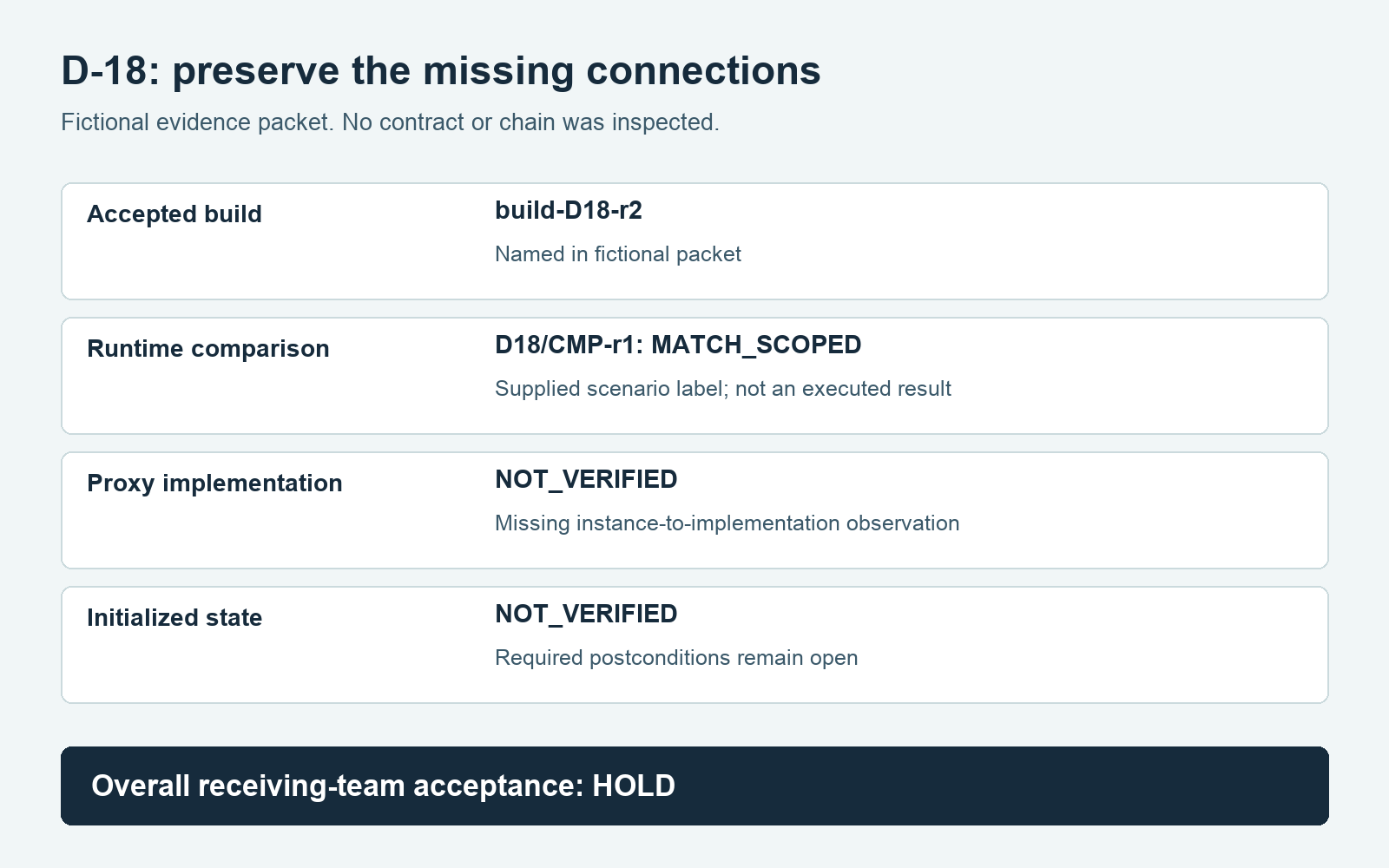
D-18 is an invented receiving-team review of an implementation-slot proxy. Its packet names artifact build-D18-r2 and supplies a fictional comparison report marked MATCH_SCOPED. That label is an assumption within the example. No compilation or bytecode comparison was performed, and none of the references below identifies a real contract.
The packet lacks the proxy's implementation observation at its selected state reference. It also lacks the agreed initialized-state evidence. The reviewer can therefore record that a supplied comparison claims a build relationship while leaving the instance-to-implementation and initialization questions unresolved. The comparison label cannot be copied into the overall verification-result field.
- D-18 evidence object: Accepted build; Fictional supplied condition: build-D18-r2 named in the packet; Review disposition: Retain its acceptance reference; no build executed here.
- D-18 evidence object: Observation point; Fictional supplied condition: D18/BLOCK-REF placeholder; Review disposition: Require actual network, block and retrieval evidence.
- D-18 evidence object: Runtime comparison; Fictional supplied condition: D18/CMP-r1 marked MATCH_SCOPED in the scenario; Review disposition: Review its method and inputs; not an executed result.
- D-18 evidence object: Proxy implementation; Fictional supplied condition: D18/IMPL-REF missing; Review disposition: NOT_VERIFIED; implementation evidence assigned.
- D-18 evidence object: Initialized state; Fictional supplied condition: D18/INIT-REF missing; Review disposition: NOT_VERIFIED; required postconditions remain open.
- D-18 evidence object: Overall deployment review; Fictional supplied condition: Incomplete artifact-to-instance connection; Review disposition: HOLD for receiving-team acceptance.
The next deliverable is specific: supply the missing proxy-routing observation and initialized-state evidence under an agreed state reference, then review them against the accepted artifact. The reviewer does not need another generic deployment-success screenshot. The existing comparison report should remain available under its original scope while the missing connections are investigated.
If later evidence identifies a different implementation, D-18 becomes a discrepancy requiring explanation. If evidence confirms the intended implementation, initialization still needs its separate review. Neither branch is demonstrated here. The fictional packet stops at HOLD, with the required evidence assigned to the deployment verification owner.
Record mismatches without changing the acceptance rule
A mismatch is useful information when its inputs remain intact. Retain the expected artifact, observed bytes, state reference and comparison method before deciding what caused it. Record whether the difference concerns executable code, linked values, metadata or an unsupported interpretation. Leave the cause unknown when the available evidence cannot distinguish those possibilities.
Separate FAIL from NOT_VERIFIED. FAIL requires evidence that a stated acceptance condition was not met. NOT_VERIFIED means the necessary inspection or interpretation remains unavailable. A missing implementation observation is not proof that the wrong implementation is active. Conversely, an observed contradiction should not be softened into a missing-document issue solely because a supplier promises to investigate.
NOT_APPLICABLE requires a reason tied to the established architecture. A genuinely direct deployment can make a proxy-routing field inapplicable. An unidentified mechanism cannot. Preserve the evidence for that architectural classification so another reviewer can see why the field was excluded rather than assume it was forgotten.
Changes to the expected build or acceptance condition need an accountable decision. Keep the old result and link the new review to the authorized change. A supplier may discover that an earlier requirement was incorrect, but correcting that requirement is different from demonstrating that the original deployment met it.
Package evidence another reviewer can retrieve
Organize the packet around the connections the reviewer must inspect. Retain the accepted build reference, deployment evidence, runtime comparison, applicable proxy route and initialized-state observations. Add the method and observation context to each record. A directory full of binaries and screenshots still needs a readable explanation of how those objects relate.
Use the manifest's ten fields as an index rather than expanding one cell into an unmanageable transcript. Link detailed build settings and chain observations from their corresponding fields. Keep the stated missing-value treatment with the export. Another team should be able to distinguish an absent observation from an explicit negative result without asking the original author.
Access is part of handover readiness. Confirm that the receiving reviewer can retrieve the retained evidence under the agreed permissions. When a reference depends on a third-party service, state that dependency and the retention arrangement actually agreed. Avoid promising an evidence lifetime that the team has not arranged or verified.
The final read-back should identify what is known, what remains open and which owner supplies the next evidence. It can accept a bounded code-identity check while withholding deployment acceptance. Keep those decisions separate in the delivery record so administrative completion does not silently become permission to operate the contract.
Ask the receiving reviewer to follow one reference without a narrated supplier walkthrough. The useful outcome is whether the reviewer can find the exact input, identify its observation scope and explain the recorded conclusion. An inaccessible export, expired evidence link or undocumented transformation creates a concrete handover task. Record the remedy and owner before closing the packet, even if the underlying code comparison itself has already been accepted.
Use proposed checks to test the review method
Before relying on the process, select a bounded set of controlled scenarios that can expose a mistaken conclusion. Agree the expected evidence and the acceptance owner first. The cases below are proposed; none was executed for this article. Adapt them to the deployed architecture and the actual tooling available to the receiving team.
- Proposed review case: Correct build, different instance; Evidence to retain: Network, address and comparison references; Question the exercise should answer: Does the review reject an unrelated deployment?
- Proposed review case: Known metadata difference; Evidence to retain: Original bytes, parsed region and method revision; Question the exercise should answer: Is the difference explained without hiding executable changes?
- Proposed review case: Changed implementation; Evidence to retain: Proxy route and implementation code at one state reference; Question the exercise should answer: Is the implementation connection checked independently?
- Proposed review case: Missing initialization evidence; Evidence to retain: Required postconditions and unavailable observations; Question the exercise should answer: Does overall acceptance stay open?
- Proposed review case: Unsupported historical lookup; Evidence to retain: Requested block and provider response; Question the exercise should answer: Is unavailable evidence retained as unresolved?
A controlled fixture supports only the behavior actually exercised. A local parser check cannot establish a public node's historical-state availability. A sandbox deployment cannot certify every production configuration. Report the observed scope and unresolved conditions alongside any completed exercise rather than promoting the worksheet itself into a test result.
Give the next observation its own revision
Retain the original review when the deployment changes. A later implementation, updated configuration or different observation block creates a new question about the same application. Link the new record to the earlier evidence, stating what changed and which conclusions still apply. Keep historical observations attached to their original state references.
A repeat review can reuse unchanged build evidence when its identity remains valid. It still needs fresh evidence for relationships that may have changed. Assign the receiving owner responsibility for deciding which observations must be collected again. Copying an earlier PASS_SCOPED label without checking its scope would conceal the new uncertainty.
Scope the supplier deliverable around the open connection
When the missing link concerns build reproduction, deployment identity or implementation evidence, bring that specific gap to Pharos Production smart contract development services. The published scope covers implementation, testing and deployment planning, while separating internal security review from independent external audit. Agree which evidence the engagement will actually supply.
Apply these acceptance questions to a Pharos Production proposal as well. Name the artifact, the deployed object, the required observations and the receiving reviewer. Keep deployment verification, application behavior and release authorization as separate deliverables where the project requires them. A useful handover ends with inspectable evidence and an explicit disposition for every connection still unresolved.
Sources and scope
Solidity compiler and metadata documentation, ERC-1967 and OpenZeppelin Contracts 5.x proxy documentation were reviewed November 9, 2026. Apply the documentation for the actual compiler and deployed library version. D-18 is fictional; this article reports no compilation, chain query or deployment verification result.
More insights to read
- A Smart Contract Upgrade Needs an Evidence Bundle
- How to Specify Token Transfer Control Deliverables
- How to Scope a Blockchain Integration Quote Across Four Acceptance Boundaries
- Smart Contract Upgrades: Who Can Approve and Reverse a Release?
- Top 5 Token Transfer-Control Architectures for Regulated Assets Compared