A Cited URL Needs Its Own Evidence: Redirects and Canonical Targets
Two fictional C-19 observations and six review cases separate the captured link, later destination and declared canonical. Preserve earlier evidence before accepting attribution.
An AI answer can cite one address while a later inspection reaches another. A canonical declaration can point somewhere else again. Before treating those addresses as one source, state which relationship you need to establish and which dated evidence supports it. TopClick's AI search and GEO services provide a context for agreeing that review scope. A link that looks familiar is a starting point for investigation, not a completed attribution decision.
Suppose a saved answer cites a review page through a redirecting address. A week later, the same address leads to an updated guide. The reviewer now sees a useful source and wants to attach it to the earlier answer. That move may be reasonable for a current navigation check, but it does not establish what the earlier page contained or which passage supported the captured answer. Keep the earlier record intact while inspecting the new destination.
This article extends the fictional C-19 example in the AI Citation Source URL Evidence Card. The original card retains one source-link review. Here, two invented observations support a comparison exercise. No AI answer, live redirect, customer record or source-page content was collected to produce these cases. The proposed decisions describe what evidence a real reviewer would need.
Separate the three addresses before comparing them
The raw citation URL belongs to the saved answer occurrence. It records the address exposed by that capture surface, beside the source label and relevant answer passage. Preserve the exact captured value and its occurrence reference. A readable source label can help locate the citation, but it cannot replace a missing href. If the capture contains only a label, record that limitation rather than reconstructing a plausible address. The observed destination belongs to an inspection. It records where the method used at that time reached, under its documented conditions. A complete redirect record may expose intermediate responses and their Location values. A final browser screenshot may show the reached page without establishing the whole chain. State which evidence exists. Do not convert a visible final address into an invented sequence of earlier hops.
The declared canonical belongs to the inspected page or response version. Keep its source alongside the value, including whether the declaration came from page markup or a response header. A declaration is not itself a captured redirect. Reading one does not show that the browser visited the declared target, that the target served matching content or that an AI product used that declaration when generating its answer.
Google Search Central describes rel=canonical link annotations as follows:
A strong signal that the specified URL should become canonical.
The statement appears in Google's guidance on specifying a canonical URL. It concerns canonicalization in Google Search. Treating the declaration as a recorded preference preserves that context. It does not establish the source-selection rules of another product or replace evidence about the answer occurrence under review. Keep the declaration, redirect destination and raw citation in separate fields even when their values happen to match.
If the inspected representation exposes several canonical declarations, retain each value and its location in the evidence packet. A value in a response header and a value in the page markup are separate observations. Where they disagree, record that disagreement rather than selecting the first value that makes the comparison convenient. The next review question is which declaration was present in which representation, not which address would make the report easier to complete.
Likewise, a reviewer asking which URL a particular system selected needs evidence from that system. A publisher declaration alone cannot fill a selected-canonical field. Keep that field unavailable when the required evidence is absent, and identify who can provide an authorized observation. This prevents a later export from presenting the page owner's preference as another system's recorded decision.
Retain the earlier C-19 record as it was supplied
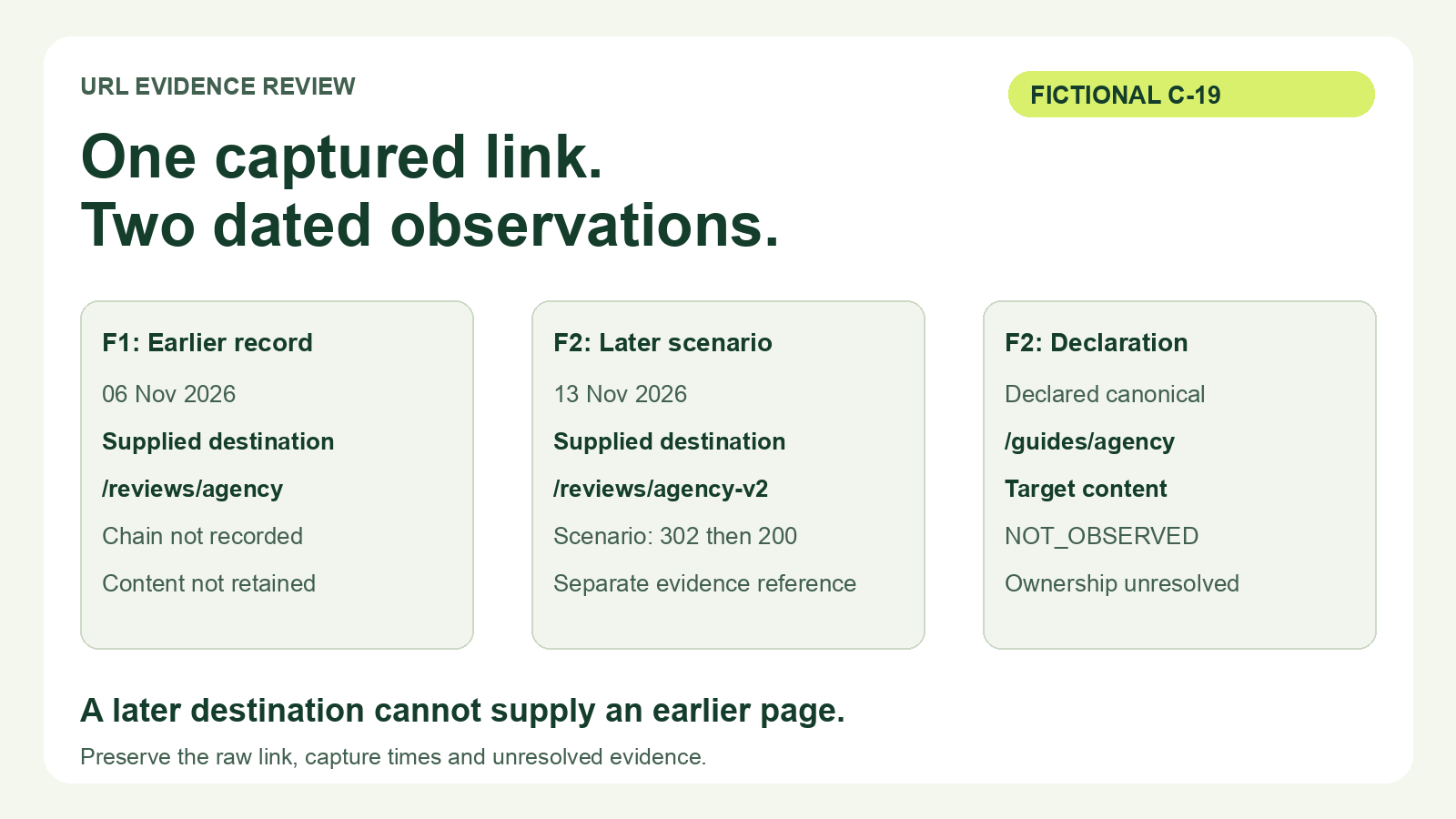
The companion card's fictional first capture is F1, dated 2026-11-06T09:00:00Z. Its raw citation URL is https://answer.example.com/citations/C-19?src=fixture. The supplied fictional destination is https://publisher.example.org/reviews/agency. The card leaves source ownership unresolved and gives the evidence review a HOLD disposition. These addresses use documentation domains and do not identify an operating citation service. F1 does not supply a complete HTTP response sequence or a canonical declaration for that destination. In this comparison, those fields remain NOT_RECORDED. Do not add a redirect status because one seems likely. Do not fetch the page today and insert its current declaration into the earlier row. A new inspection can create useful evidence, but its time and method belong to a new observation.
Retaining that boundary matters when another reviewer inherits the record. A destination string says what the fictional example supplied. It does not demonstrate how a real resolver reached that address. The missing chain remains a limitation even if every other field looks complete. Carry that limitation into the comparison request so the receiving reviewer does not assume a stronger capture method than the original record supports.
For a real review, preserve the permitted source snapshot or excerpt that informed the earlier decision. Include its capture reference and the conditions under which it was obtained. If no such content was retained, record CONTENT_NOT_RETAINED. A currently reachable page is not a substitute for an absent historical snapshot. A publication date printed on the page does not establish that its contents were unchanged throughout the intervening period.
Add a later observation without rewriting F1
For the invented second observation, F2, use 2026-11-13T09:00:00Z. Keep the same raw citation URL as F1. The new scenario supplies a 302 response to https://publisher.example.org/reviews/agency-v2, followed by a 200 response there. The supplied page declares https://publisher.example.org/guides/agency as canonical. These are fictional response facts for the walkthrough, not the result of a network test. Give F2 its own evidence reference, E-C19-F2, and its own page-version reference, PAGE-C19-F2. Keep the canonical target's content status NOT_OBSERVED: the scenario supplies the declaration but no inspection of that target. Keep domain ownership UNRESOLVED, matching the earlier review boundary. Neither a redirect nor a canonical annotation settles who controls a publisher's domain.
The immediate comparison is narrow. F1 and F2 retain the same raw link, while their supplied destinations differ. The later scenario also contains a canonical declaration that F1 never recorded. That supports SAME_RAW_LINK and DESTINATION_CHANGED_IN_SCENARIO. It does not support a finding that the two source versions contain the same evidence or that either destination belongs to the promoted company.
Do not read the two fictional dates as the exact moment a route changed. They define the scenario's observation times. Even with real captures at those times, a reviewer would need additional evidence to locate a change within the interval. The defensible statement is that the supplied observations differ. A precise deployment time or uninterrupted behavior between observations would require its own evidence source.
F2 can be useful without repairing F1's missing fields. It gives the team a current scenario to inspect and a reason to request historical page evidence. Link the observations through C-19, but keep their individual identities. If the record later receives a correction, describe which field was corrected, why and which evidence supports the change. Preserve the earlier value in the review history.
Record the method behind each field
A timestamp is useful only beside a description of what was captured. An answer export may preserve a source link without exposing how the product resolved it. A browser inspection may reveal a final address and readable content. A response capture may expose status codes and Location values without reproducing every client-side behavior. Name the actual method used for each field instead of assigning one method to the entire packet by default.
Keep the collection context with its evidence reference. State the answer surface, inspection environment and known conditions that matter to the result. Where an authorized account or session was required, record the dependency without publishing credentials or private session details. A later anonymous check and an earlier authenticated inspection can produce different representations. That difference needs explanation before their content is treated as interchangeable evidence.
Use separate times when the answer capture and destination inspection occurred at different moments. A single date column can hide a long delay between them. For example, a reviewer may save an answer on one day and inspect its sources later. The answer record establishes when the citation was captured. The inspection record establishes when the destination was examined. Neither timestamp should be silently copied into the other's field to make the packet look contemporaneous.
Write an unavailable value as unavailable. If the original collection did not retain a canonical declaration, today's inspection cannot recover what that declaration was then. A later inspection can still be attached as a new observation with its own limits. The distinction should survive an export: a receiving reviewer should see both the retained earlier fields and the new inspection without reconstructing the sequence from file modification dates.
For the fictional record pair, use the following compact review entries. The field values express the scenario and proposed decision state only. They are not captured responses from a running service.
F1 comparison entry: observation F1. Scenario time 2026-11-06T09:00:00Z. Raw link C-19. Supplied destination /reviews/agency on the publisher documentation domain. Redirect sequence NOT_RECORDED. Canonical declaration NOT_RECORDED. Historical content CONTENT_NOT_RETAINED. Ownership UNRESOLVED. Evidence reference E-C19-F1.
F2 comparison entry: observation F2. Scenario time 2026-11-13T09:00:00Z. Raw link C-19. Supplied destination /reviews/agency-v2 on that domain. Scenario sequence 302 then 200. Declared canonical /guides/agency on that domain. Canonical target content NOT_OBSERVED. Ownership UNRESOLVED. Evidence reference E-C19-F2.
These entries intentionally leave gaps that a neat address comparison cannot fill. The apparent continuity of C-19 does not supply F1's absent page content. F2's extra declaration does not settle control of the publisher. A reviewer can compare the two records while returning an unresolved historical attribution decision, rather than choosing the most convenient current address and calling the review complete.
Give the comparison its own question and disposition
A useful comparison record begins with the question. For C-19, ask whether the later destination can support an attribution claim about the earlier answer occurrence. Then name F1 and F2, their capture times and their evidence references. Include the raw URLs, supplied response sequences, final destinations and canonical declarations without forcing those values into a single preferred-address column. Add a result for each relevant axis: raw-link identity, destination identity, declaration comparison and content support. Some questions need only one axis. A current broken-link check might care about destination reachability. A review of an earlier factual claim needs the retained answer passage and the source content that supports it. State the intended use so the same record is not silently reused as proof of a different conclusion.
For the worked comparison, the proposed disposition is HOLD_FOR_EARLIER_CONTENT. The missing evidence is the earlier source passage or permitted historical page snapshot. The receiving role is the source-review owner. The acceptance condition is a documented passage comparison against the retained answer excerpt, with page-version references. This disposition does not assert that the claim is unsupported. It identifies why the available scenario cannot settle it.
Keep the question, evidence sufficiency and next action together. A bare SAME_SOURCE label hides whether the reviewer compared addresses, source control or substantive content. A qualified result is more useful: same captured link, different supplied destinations, historical content unresolved. Another reviewer can accept that description while disagreeing about the next investigation step, without either person rewriting the underlying records.
Work through six comparison boundaries
The following cases are proposed review rules applied to fictional inputs. They are not an evaluation of an AI engine, a production resolver or a customer's monitoring system. Use the labels to prepare a decision record, then supply real evidence within the approved scope. Each case states the narrow relationship the input supports and the broader conclusion that still needs evidence.
Same raw link, different later destinations
F1 and F2 share the captured C-19 address, while the supplied destinations differ. Preserve both destination observations and report the difference with their dates. The raw-link match locates the comparison. It cannot prove that the old destination redirected to the new one at the earlier capture time, because F1 never retained that sequence. Request the missing historical evidence only if it is necessary to answer the agreed question.
Different raw links, one observed destination
Imagine another captured address reaches the same destination as F2 during a later authorized inspection. Record that convergence for those observations. Do not erase the two source occurrences or state that both earlier answers cited the same page version. A shared current destination can guide investigation, but a passage-level claim still depends on the content and capture context attached to each occurrence.
Same destination, changed canonical declaration
Suppose two inspections reach the same address but retain different declared canonical targets. Record a declaration change between the captured versions. That difference does not establish that the inspected content changed, and the stable destination does not establish that it stayed the same. Compare the retained page versions if the review requires a content conclusion. Keep the declaration's source and inspection time with each value.
Shared canonical target, different source content
Suppose two retained source pages declare the same canonical target while the passages relevant to the answer differ. The shared declaration remains a fact about those versions. It does not make their passages interchangeable. Attach the claim-support decision to the actual retained content and answer occurrence. If the canonical target itself was never inspected, keep that additional content question explicitly unresolved.
Final address visible, redirect chain missing
A reviewer may have a final-page capture without the intermediate responses. Record the visible destination under that method's limits. Leave the chain NOT_RECORDED. Do not infer that the absence of a trace means no redirect occurred. If the question concerns where a selector or source identity changed, request a suitable response capture rather than treating the final address as a reconstruction of the route.
Current target unavailable
A later inspection might encounter a login screen, access denial or loop. Preserve the earlier citation occurrence when its capture exists. Record the current inspection outcome separately and identify which evidence remains unavailable. A failed later inspection cannot establish that the answer contained no citation. It also cannot establish that the inaccessible target supports the claim. Keep both boundaries visible in the disposition.
Ask for the missing evidence with an acceptance condition
An evidence request should identify the unresolved comparison axis. For C-19, the source-review owner needs earlier content evidence to decide whether F2 can support a claim about F1. The request should name the retained answer excerpt and the source passage or page version to compare. Asking someone to confirm the source is too vague: it leaves them free to confirm reachability while the original dispute concerns historical claim support.
Give the receiver a usable evidence pointer. If the reviewer cannot access the saved answer or earlier page record, the comparison is still incomplete. Record the access limitation and its owner without copying restricted contents into a public worksheet. A redacted reference can show that the evidence exists and requires authorized access. It cannot stand in for the passage comparison when that comparison is necessary to the decision. Use a bounded return condition. The receiver can return the required excerpt comparison with version references, report that the permitted archive lacks the material or explain why the evidence cannot be accessed. Those outcomes support different dispositions. Do not require an unconditional acceptance label when the evidence may legitimately remain unavailable. A documented unresolved result is more useful than a confident label whose supporting material nobody can retrieve.
When evidence arrives, attach it as a review revision. Preserve the prior HOLD disposition and explain what the new material establishes. A historical snapshot could support one passage while leaving domain control unresolved. A domain-control record could settle ownership without supplying the missing historical text. Close only the question the evidence actually answers, and retain the next action for any remaining question.
The final review record should name the decision owner and the question they accepted. Include the observation references, policy or review rule used, disposition date and remaining limits. If another team needs to use the result for reporting, give them the permitted interpretation explicitly. A decision made for current source navigation should not quietly become a claim that historical answer support has been verified.
Keep a convenient address from becoming the whole record
Teams often want a single address that makes a report easier to read. A display address can serve that purpose if it is clearly separate from the captured evidence. Show the original occurrence and its dated inspections behind that display value. The reader should be able to recover which observation supports a statement about the source without guessing whether the displayed address came from a redirect, a declaration or an editor's preference. Do not let the display choice change the comparison question. If the interface displays the canonical target for convenience, keep an indicator that it was declared by the inspected page and whether its content was checked. If it displays the final destination, retain the raw captured link. These details help a receiving reviewer see which part of the record is evidence and which part is a presentation decision.
A correction also needs a visible scope. Replacing a mistyped source URL with the exact value from the retained answer is different from replacing it with today's destination. The first repairs transcription with supporting evidence. The second creates a later interpretation. Preserve the reason and original value in either case so exported review records can be reconciled without rewriting the history of what the team previously saw.
This comparison method leaves normalization and aggregation policy to a separate implementation. It does not define how many documents a dashboard should count or how to merge URLs at scale. Its job is smaller: make the relationship between two observations explicit enough that an attribution decision can be reviewed. Keep that decision available even when a later reporting policy changes its preferred grouping key.
Scope the next review around the disputed relationship
Bring one disputed pair of observations to a review rather than starting with a broad demand to improve citations. Include the question, both timestamps, the saved answer reference and the evidence that is currently missing. A receiving team can then say which part it can inspect, which access it needs and what deliverable would let the decision owner resolve the dispute.
TopClick's technical SEO canonical review fits a scoped discussion of redirects, duplicate pages and canonical declarations. Its published service scope includes specifications and verification after implementation, with the implementation route agreed in writing. That scope can inform the work request. It does not establish that a supplier has inspected the fictional C-19 records or delivered a particular attribution outcome.
For the proposed C-19 handover, retain F1 and F2 as distinct records. Keep the raw-link match and changed supplied destination explicit. Leave historical content and source ownership unresolved until the appropriate evidence arrives. Name the receiving owner and the condition for returning the review. The final record should make it possible to tell which question was answered, by which evidence, at which time.
Sources and scope
- Google Search Central: specifying a canonical URL
- Google Search Central: redirects and Google Search
- IANA: example domains
Source scope checked November 13, 2026. F1, F2, their dates and response facts are fictional. No AI answer, redirect or customer implementation was tested for this walkthrough.
More insights to read
- AI Visibility Baseline: Keep Mentions and Citations Apart
- Technical SEO Release Gates for JavaScript Sites: Compare Source and Rendered HTML
- AI Citation Monitoring: Normalize URLs Without Losing the Evidence
- Technical SEO Fixes: Name the Implementer Before Accepting the Audit
- Test an AI Visibility Parser Against Missing Answers and Citation Links